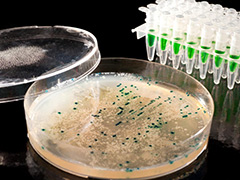
As renewable energy initiatives catch up with technological capabilities, we can look to an unlikely testing ground for solutions to emerge: wastewater. As reported in the science journal Nature, scientists have found a breakthrough in creating micro-biotic life, a genetically modified strain of E. Coli to be exact, which feeds off of wastewater and converts it into something we can use. That something is gasoline.
We all know that diesel can be made from bio-engineering, and plastics, but it hasn’t been reported that petrol, in its refined state of gasoline, was possible to synthesize until now. It all happens through the development of “platform Escherichia coli strains that are capable of producing short-chain alkanes (SCAs; petrol), free fatty acids (FFAs), fatty esters and fatty alcohols through the fatty acyl (acyl carrier protein (ACP)) to fatty acid to fatty acyl-CoA pathway.”
Yes, those unruly bacteria that make the news a couple times a year for tainting some cheap imported produce might actually be a resource for alternative fuel pioneers in the coming years. Better still, this strand of E. Coli can potentially be modified to convert livestock waste, which could be integral in developing systems that transform waste into energy on a larger scale.
What the future holds for the development of this technology will remain to be seen, but what is key is the implementation of waste to energy conversion is integrated into our supply chain from the ground up. Other companies like MicroMidas, are trying to do just that with bio-engineered plastics created from biomass. Their process “uses a chemo-catalytic process to convert cellulosic biomass directly into para-xylene, a precursor to PTA.”
That’s right, polyester, harvested from engineered microbes creating enzymes that in turn create plastic. As this technology continues to show its merits, we will continue toward a path of becoming carbon neutral.